domingo, 2 de julho de 2017

Al-Jazeera, insurgent TV station that divides the Arab world, faces closure

Image result for the guardian logo


The network has raised political awareness across the Middle East. No wonder Qatar´s conservative enemies want it shut down
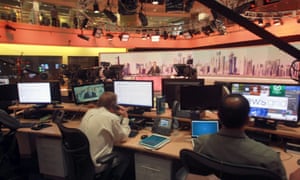

The al-Jazeera studios in Doha.

 The al-Jazeera studios in Doha. Photograph: Naseem Zeitoon/Reuters

On Monday a bold and controversial experiment in Middle Eastern media and politics may be abruptly brought to an end. Al-Jazeera – once heralded as the beacon of free Arab media that broke the hegemony of the western networks and reversed the flow of information from east to west for the first time since the middle ages – faces closing its doors for good.
On 23 June, Saudi Arabia, the United Arab Emirates, Bahrain and Egypt subjected Qatar to unprecedented diplomatic and economic sanctions, followed by an aggressive blockade and threats of further action if Qatar fails to meet a list of 13 demands, one of which is to shut down the al-Jazeera network.

If Doha capitulates – and there are no signs it will – it will effectively have lost its sovereignty and become a vassal state of Saudi Arabia and the UAE. Yet defying the deadline could lead to regime change in Qatar, or even war.
Whatever happens, it is a credit to al-Jazeera that, 21 years after its launch, it is still so disruptive and challenging to those in power. Few other media outlets can claim to be so influential. But al-Jazeera is not like other broadcasters. It is a unique phenomenon which, since it started broadcasting in 1996, has revolutionised the Arab media, and in 2010 played a major role in bringing about a real political revolution across much of the Arab world.
Before al-Jazeera started broadcasting, Arab television news was totalitarian drivel. The news chiefly focused on what the sheikh, emir or president was doing that day, some news about his heir, and a puff piece about how lucky the nation was to have such heroic father figures. Al-Jazeera blew all this away, allowing all kinds of previously banned voices to be heard, from the Israelis and Muammar Gaddafi to Chechen rebels, the Taliban and Osama bin Laden.
In its glory days, Arab cities would go noticeably quieter when Dr Faisal al-Qassem’s The Opposite Direction show came on air, and the network’s long list of scoops includes its coverage of Operation Desert Fox in Iraq in 1998, a post-9/11 interview with bin Laden, and the US-led invasion of Afghanistan, when al-Jazeera was the only TV network present in the country and for a few weeks became news agency to the world.

Osama bin Laden in a recording broadcast by al-Jazeera a month after 9/11.
Pinterest
 Osama bin Laden speaks from an undisclosed location in a recording broadcast by al-Jazeera a month after 9/11. Photograph: AP
Al-Jazeera was the first Arab channel to introduce proper investigative journalism and the first to entertain all kinds of previously off-limits guests on its talk shows, tackling controversial topics such as suicide bombing and the existence of God. Such iconoclasm demolished social, political and religious taboos and set a new standard of reporting in the region. It introduced concepts like democracy and human rights and drastically pushed back the boundaries of free speech.

It also deeply disturbed other governments in the region since none of them, with the exception of post-revolutionary Tunisia, enjoys a popular democratic mandate and they fear anything that might weaken their grip on power. A stream of never-ending diplomatic crises kicked off between Qatar and every other country in the region except Oman, as well as many non-Arab nations. The network’s myriad enemies used every trick in the book to try to shut it down, from arresting correspondents and closing bureaus to deporting family members of employees, harassing potential advertisers, launching frivolous lawsuits and, in the case of the US, bombing its offices twice and killing members of its staff.

After years of failing to make an impact, Arab governments finally realised that the only way to deal with al-Jazeera is to beat it at its own game, which is why in 2003 Saudi Arabia started arch rival al-Arabiya TV. Since no reliable viewing data is available we cannot know for sure which of the two is the more popular today. Despite al-Jazeera currently being banned in Egypt – the most populous Arab country – arguably it is still al-Jazeera, but naturally al-Arabiya disputes this.
It is important to remember that al-Jazeera is not the only bone of contention between Qatar and its neighbours. Saudi Arabia and Qatar may be the world’s only two Wahhabi states, but they also have numerous historical and ideological differences, as evidenced by the list of 13 demands. Al-Jazeera is on the list because it is such a powerful symbol of Qatar and the most visible manifestation of Qatari policymaking. But there is a deeper reason, which for westerners to understand they must consider that al-Jazeera has two faces – one Arabic and one English – and it is the Arabic face that creates all the problems in Qatar’s neighbourhood.


Current Time0:00
/
Duration Time0:53
Loaded: 0%
Progress: 0%

Mute
Pinterest
 ‘We call on all governments to respect media freedoms’: al-Jazeera on Saudi demands for its closure – video
The English face of al-Jazeera is one westerners have grown familiar with: the al-Jazeera English channel and website, high quality news and sophisticated documentaries focused on the developing world. Compared with alternative English-language international news channels, such as BBC World, CNN International, France 24, and Russia Today, most observers agree al-Jazeera English scores highly.
The biggest failure of al-Jazeera’s English language operation so far has been its inability to crack the US market, but even the BBC struggles there and this is probably more a reflection on the level of sophistication of the average US viewer, rather than al-Jazeera’s output. In the UK, where we are comparatively spoilt for quality media, AJE is widely regarded as one of the leading broadcasters, a worthwhile alternative to the BBC, Sky or Channel 4.
Beyond also being a 24-hour news channel, al-Jazeera Arabic (AJA) is a very different beast in terms of language, content and frame of reference to al-Jazeera English. This is hardly surprising given that they are aimed at entirely different audiences.
What makes Qatar’s neighbours uncomfortable about AJA is the channel’s success in forging a new political awareness among Arabs and raising issues, such as social justice and human rights. What they find particularly distasteful is the widely propagated view, shared by the Qatari leadership, that sooner or later Islamist groups, such as the Muslim Brotherhood and Hamas will come to power across the whole region, propelled either by revolution or democratic elections.
Since this is also an issue of concern for Israel and many others in the west, it is a point Qatar’s Arab neighbours have focused on, although since Hamas is popular with the Arab public it was not named in the list of demands.
Given that on the few occasions Sunni Arab countries have been able to hold free and fair elections Islamist parties have usually won, even though they are not often allowed to take or hold power for long, Qatar’s assumption that one day they will come to power is not unrealistic. But for Qatar’s neighbours it is heretical.
The Arab regimes persecuting Qatar today – the counter-revolutionary axis in the region – are all vulnerable to being overthrown by popular revolution and replaced by Islamist groups, so seeing these same groups presented as legitimate political opposition on al-Jazeera and being allowed to agitate for political change represents a clear existential threat.
The counter-revolutionary axis expends significant resources suppressing and demonising many of the same individuals and groups – “terrorists” – to which al-Jazeera gives voice. The problem for them is that Qatar seems to be on the right side of history.
Arabs generally are fed up with their corrupt and useless unelected governments and are ready for any alternative in future, as long as it looks nothing like the past. Many Sunni Arabs, liberals and Islamists alike, find al-Jazeera’s democratic, Islamist discourse and optimistic vision of the future much more inspiring than the visions their widely hated and feared governments are peddling.
Qatar, of course, is also an autocratic government, but since it is so small and rich, normal rules do not apply to it. This is why it has shown no sign of giving in to any of the demands placed on it, even though the deadline expires on Monday.
Hugh Miles is the author of Al-Jazeera: How Arab TV News Challenged the World. He is a Cairo-based freelance journalist specialising in the Middle East, and editor of ArabDigest.org

terça-feira, 27 de junho de 2017

E.U. fines Google a record $2.7 billion in antitrust case over search results

Resultado de imagem para logo washington post


 Play Video 1:33
E.U. fines Google record $2.7 billion in antitrust case
Embed 
Share 
The European Union’s antitrust chief announced a record breaking fine of $2.7 billion against Google for distorting internet search results.(Reuters)


 The European Union’s antitrust chief hit Google with a record $2.7 billion fine Tuesday, saying the powerful web-search leader illegally steered users toward its comparison shopping site and warning that other parts of Google’s business were in the crosshairs.
The fine is the largest the European Union has levied against a company for abusing its dominant position, and marked the latest confrontation over business practices between E.U. regulators and American tech giants. Google could face dizzying additional penalties if it loses an expected appeal and fails to comply.
If the ruling stands, it could reshape the company’s behavior in one of its most lucrative markets. And the way Google presents its search results could shift worldwide. 
The landmark E.U. decision also sets up a wider clash — touching on whether government regulators hold power over one of the world’s most dominant companies, and testing the limits of competition-regulating rules in an age of borderless commerce and online interactions.
“Google has abused its market dominance in its search engine by promoting its own shopping comparison service in its search results and demoting its competitors,” E.U. competition chief Margrethe Vestager told reporters in Brussels.
“What Google has done is illegal under E.U. antitrust rules. It has denied other companies the chance to compete on the merits and to innovate. And most importantly, it has denied European consumers the benefits of competition.”
The decision reinforced Vestager’s emerging role as the world’s most aggressive antitrust regulator, following on a $14.6 billion back-tax judgment against Apple last year.
The announcement caps a seven-year investigation into Google’s trade practices. Other related cases against Google are ongoing.
Google — which is considering an appeal — issued a statement minutes after the E.U. announcement, claiming the company’s shopping site helps both consumers and advertisers.
“When you shop online, you want to find the products you’re looking for quickly and easily. And advertisers want to promote those same products,” said Google senior vice president and general counsel Kent Walker in a statement.
“That’s why Google shows shopping ads, connecting our users with thousands of advertisers, large and small, in ways that are useful for both. We respectfully disagree with the conclusions announced today,” he said. “We will review the Commission’s decision in detail as we consider an appeal, and we look forward to continuing to make our case.”
Under European rules, it is up to Google to find a way to comply with the judgment, and Vestager offered no specific guidance about how it must modify its services.
If it does not abide by the ruling within 90 days, however, Google could face penalties of up to five percent of the daily turnover of Alphabet Inc., its corporate parent, which could be backdated years.
Alphabet shares were down in midday trading on Wall Street.
“This is really sending a message to Google: change or we’ll come after you,” said Thomas Tindemans, the chairman of the Brussels office of Hill+Knowlton Strategies, a consultancy, who has worked on previous technology antitrust cases.
Europe’s vast unified market gives regulators extra clout as they take on international business titans. With more than 500 million residents, the 28-nation bloc has more consumers than the United States. And its regulations about fair business practices tend to be stricter than Washington’s, meaning U.S. tech companies are often a focus.
The holder of the previous record fine was Intel, the chip manufacturer, which was hit with a $1.2 billion penalty in 2009.
The E.U. antitrust chief, a former deputy prime minister of Denmark, said Google had illegally taken advantage of its juggernaut standing in the world of search engines, pushing users toward its comparison shopping service and advertisers over those of rivals. 
The European Commission directed Google to open up its shopping search results to the tech company’s competitors.
“They’re going to have to change their conduct,” said Thomas Vinje, legal counsel to FairSearch, a lobbying group that has helped organize the legal challenge to Google in Europe.
And as President Trump advocates a fierce America-first policy of trade protectionism, the ruling also raised questions about how his administration would respond to the broadside hit against one of the richest companies in the United States.
The answer was not immediately obvious.
Trump has spoken at times of a need for aggressive antitrust regulation, and Google’s close ties to the White House under President Obama have been severed under the new political order.
Trump’s own relationship to the tech industry has become strained amid decisions to impose travel restrictions on some Muslim majority countries and to withdraw from the Paris climate agreement, two issues that clash with Silicon Valley’s socially liberal culture. But several U.S. companies, including Yelp and Expedia, were official complainants in the European case against Google, dampening the Europe vs. America dynamic.
A White House spokesman declined to comment on the E.U. case against Google, saying the administration would take no position on pending litigation.
Yelp said Tuesday that it had not decided whether to press its case against Google before U.S. regulators. “We are going to leave all options on the table,” said Luther Lowe, Yelp’s vice president of public policy.
Despite Trump’s populist rhetoric, the president lacks direct influence over any potential investigation by the Federal Trade Commission or the Justice Department, the two agencies that could conceivably conduct a probe into Google. He could shape the process by appointing senior officials to DOJ or the FTC who may be more inclined to pursue an aggressive antitrust agenda. But Trump has also been slow to fill those seats.
If U.S. regulators agree to reopen a probe, the resulting investigation may not necessarily lead to an enforcement action. And any action against Google would likely need to pass muster before a judge, said Diana Moss, president of the American Antitrust Institute. Such a process could take years to play out.
“All of these vacancies are I think putting a lot of stress and pressure on the enforcement infrastructure at a time when we badly need our competition enforcement infrastructure to be moving smoothly and efficiently,” said Moss. “There are a lot of cases on deck — things are stacking up in the pipeline.”
The Federal Trade Commission closed a similar investigation against Google in 2013 in exchange for Google’s changing some of its business practices.
“The lion's share of work on this case has been advanced by U.S. companies who had to go to Europe after a politically captured FTC failed them,” said Luther Lowe, vice president of public policy at Yelp, a review website that is one of the complainants in the Google case.
Antitrust lawyers on both sides of such cases in Europe usually dismiss allegations of anti-U. S. bias in the judgments, saying that U.S. tech companies become a focus because they are dominant in their field, not because they are American.
“The key principle is that antitrust has been and should remain apolitical, for a good reason,” said Anthony Gardner, who worked on European antitrust issues before he became Obama’s ambassador to the European Union in 2014.
“I pledged during my three years as ambassador that I would never make any policy statement lobbying on behalf of any company,” he said, adding that he was not commenting on the facts of the Google case.
In April, Google chief executive Sundar Pichai said shopping inquiries had increased 45 percent in the past year.
“Our investments in innovative ad formats, improved targeting and better measurement are really helping retailers, who see us as an ally in their corner,” Pichai told investors while discussing the first-quarter earnings of parent company Alphabet.
 Last month, Facebook agreed to pay $122 million in fines to the European Union over charges that it misled regulators during its 2014 acquisition of WhatsApp. The fine was among the largest the company has had to pay to any government.
European regulators claimed Facebook was not honest about its ability to identify users who had both Facebook and WhatsApp accounts and link those accounts. At the time of the merger review, regulators were particularly concerned that WhatsApp users would have their information shared with Facebook without their consent. 
Brian Murphy and Brian Fung in Washington contributed to this report

segunda-feira, 26 de junho de 2017

Facebook Is Going Hollywood, Seeking Scripted TV Programming

Image result for fox business logo
Resultado de imagem para the wall street journal


By Joe Flint and Deepa Seetharaman  
Features Dow Jones Newswires

Facebook Inc. to Hollywood: Let's do lunch.
The social-networking giant is talking to Hollywood studios and agencies about producing TV-quality shows with an eye toward launching original programming by late summer, people familiar with the matter said.
In meetings with major talent agencies including Creative Artists Agency, United Talent Agency, William Morris Endeavor and International Creative Management Partners, Facebook has indicated it is willing to commit to production budgets as high as $3 million per episode, people familiar with the situation say.
That's the price range of high-end cable-TV shows. Facebook is also interested in more moderate-cost scripted shows in the mid-to-high six-figure-per-episode range, these people say. The company will be aggressive about trying to own as much of that content as possible.
The push for TV shows is part of a two-track effort at Facebook to up its game in video and target the tens of billions of ad dollars spent on television.
Facebook also is seeking short-form content, primarily unscripted, that could run for 10 minutes in the Spotlight section for videos, the people familiar with the matter say.
The social network is guaranteeing creators of short-form fare a minimum $5,000 to $20,000 share of ad revenue per episode, a person familiar with the company's strategy said. Companies working on such content for Facebook include BuzzFeed, ATTN and Refinery 29, according to people familiar with the situation.
Facebook declined to comment on specifics of its content plans. In a statement, Vice President of Media Partnerships Nick Grudin said, "We're supporting a small group of partners and creators as they experiment with the kinds of shows you can build a community around -- from sports to comedy to reality to gaming. We're focused on episodic shows and helping all our partners understand what works across different verticals and topics."
Facebook has told people in the industry that late summer is a bit of a moving target for launch. It hopes to target audiences from ages 13 to 34, with a particular focus on the 17-to-30 range. It appears to be seeking shows along the lines of the drama "Pretty Little Liars" on Freeform, the cable channel formerly known as ABC Family, or similar to ABC's "Scandal" and reality hit "The Bachelor," people familiar with the matter say.
Among the shows Facebook already has lined up is "Strangers," a relationship drama aimed at millennials that made its debut at the Sundance Film Festival, and the game show "Last State Standing."
Facebook is willing to take another network's castoffs or "distressed assets," as one entertainment executive put it. The company is nearing a deal for the family comedy "Loosely Exactly Nicole," which Viacom's MTV canceled earlier this year after one season. An executive familiar with the show said its budget was in the $1 million-per-episode range.
"Loosely Exactly Nicole" is near and dear to Mina Lefevre, who developed it while at MTV and now heads Facebook's development effort, reporting to Ricky Van Veen, founder of the website CollegeHumor, who joined Facebook last year.
Facebook has told people it wants to steer clear of shows about children and young teens as well as political dramas, news and shows with nudity and rough language.
Facebook enters a bustling TV scene where old and new players are creating a staggering amount of original programming, making it hard for even good shows to break through. Last year there were more than 455 scripted shows on TV.
Compared with digital players such as Netflix Inc., Amazon.com Inc. and Hulu, which have been in TV for years now and have well-stocked pipelines of original programming, Facebook is late to the game. Apple Inc. is also hunting for original TV programming and just hired two top executives from Sony Corp.'s TV studio.
The longer-form scripted shows on Facebook are expected to run no more than 30 minutes and will carry ads. A potential challenge for Facebook is Hollywood's desire to own much of its content. Typically, studios and producers effectively rent their shows to networks through licensing deals, and are reluctant to part with rights to shows in perpetuity.
The entertainment industry is eager to see if Facebook can translate the data it has on tastes and habits of nearly two billion monthly users into insights that make for more popular television.
Facebook is expected to spread out the release of its episodes, in the traditional fashion, rather than dropping an entire season at one time, as Netflix and Amazon do, the people familiar with the matter say. Facebook sees its platform as an in-house water cooler of sorts, ideal for building a social community around shows.
In another move that will distinguish it from Netflix and Amazon, Facebook is also telling Hollywood it will share viewership data with them.
"Facebook is saying, 'We're going to be completely transparent,' " one agent said. " 'You'll share in our ad dollars, our profits will be your profits, you will get all the data.' It's a humongously different mind-set."
--
Jack Marshallcontributed to this article.
Write to Joe Flint at joe.flint@wsj.com and Deepa Seetharaman at Deepa.Seetharaman@wsj.com
(END) Dow Jones Newswires